

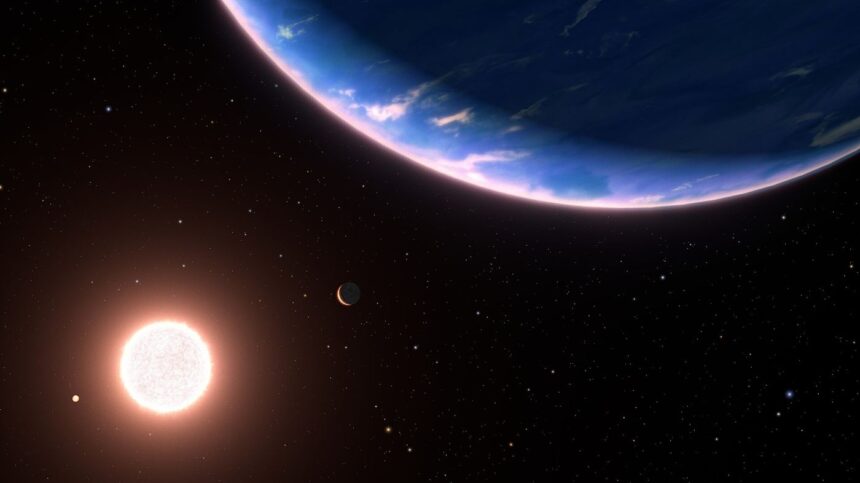
The James Webb Space Telescope has shown that a rocky exoplanet just 6.9 light-years away has no substantial atmosphere, a finding that tests the limits of where atmospheres can survive. The planet, LTT 1445 A b, was studied in secondary eclipse, when it passes behind its star, and the measurements were posted to the arXiv preprint server on 12 November 2026. The eclipse depth of 157 parts per million corresponds to a brightness temperature of roughly 528 Kelvin, consistent with a bare rock heated by its star. The planet orbits an M-type red dwarf, a small cool star whose harsh radiation usually strips away the gases around nearby worlds. It sits closer to the predicted Cosmic Shoreline than any other rocky world examined in secondary eclipse so far.
What the Evidence Shows
The Cosmic Shoreline is a theoretical boundary that separates planets able to hold an atmosphere from those that cannot, based on how much starlight they receive and how strongly their gravity holds gas. LTT 1445 A b lives right on that edge, which makes it a valuable test of the idea. The system also holds a second rocky planet, LTT 1445 A c, in a compact arrangement with its sibling. Astronomers studied the planet across multiple eclipses, combining the new measurements with archival transit and radial velocity data. The result adds to a growing picture from Webb: many rocky planets around red dwarfs appear to be bare rocks, and the search for a truly Earth-like atmosphere may need to look at planets around quieter, more Sun-like stars. Reporting and analysis from sources such as Nature track the same developments, and specialists following the rocky exoplanet LTT 1445 A b say the direction is now consistent across independent lines of evidence.
The Wider Context
The wider context is a research landscape in which replication and open data now decide reputations. Findings connected to the rocky exoplanet LTT 1445 A b are being checked by independent groups with shared datasets, and the teams involved publish their methods in full so rivals can test every step. That discipline is slower than a headline cycle, but it is why results in this area increasingly survive first contact with scrutiny.
What Happens Next
What happens next in the story of the rocky exoplanet LTT 1445 A b will be decided by follow-up work already under way: larger samples, longer observation and instruments that have not yet come online. The researchers involved are unusually united on one point, that the current results justify the next investment of time and money. Readers will not have to wait long for the first tests of that claim. You can follow related developments in our coverage of science.
None of this will be settled by a single announcement, study or product launch. The pattern to watch is accumulation: independent confirmations, honest reporting of failures and steady improvement in the underlying numbers. Readers who follow those signals, rather than the loudest claim of the week, will understand this subject better than most of the commentary surrounding it suggests is possible.