

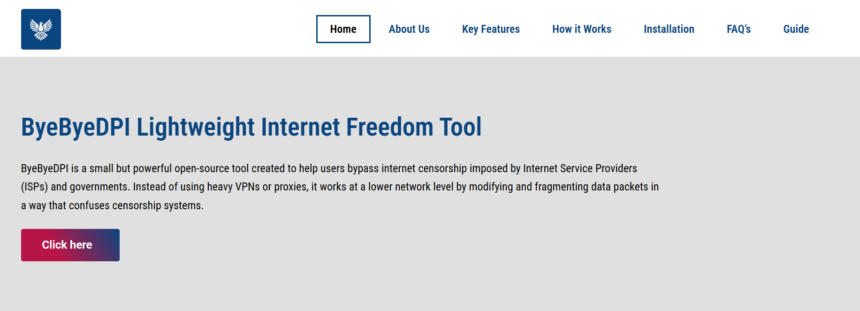
In recent years, internet users around the world have become more aware of online censorship, traffic monitoring, and content restrictions. This shift has led to rising interest in tools that can bypass Deep Packet Inspection (DPI) systems. One of the emerging solutions gaining attention is byebyedpi, a lightweight method designed to help users access blocked content without relying on traditional VPN services.
Its growing popularity is not random—it is driven by performance needs, privacy concerns, and the limitations of older bypass technologies.
What Makes ByeByeDPI Different?
Unlike VPNs or proxies that route traffic through external servers, ByeByeDPI works locally on the user’s device. It modifies network packets in a way that makes DPI systems struggle to correctly identify blocked traffic.
This approach has several advantages:
- No dependency on remote servers
- Lower latency compared to VPN routing
- Reduced detection by filtering systems
- Lightweight system resource usage
Because of this design, it appeals to users who want faster browsing without sacrificing accessibility.
Rising Demand for Privacy and Unrestricted Internet
1. Increasing Internet Restrictions
Global reports on internet freedom (such as Freedom House “Freedom on the Net”) show that many countries continue to implement or expand digital censorship systems. These systems often rely on DPI to block websites, streaming platforms, and social media services.
As restrictions increase, users actively look for tools that are harder to detect and block.
2. VPN Limitations Are Becoming More Visible
VPN usage has grown significantly worldwide over the past decade. Industry analyses suggest that global VPN adoption has increased steadily, especially in regions with strict internet controls.
However, users face several common issues with VPNs:
- Reduced internet speed due to server routing
- Subscription costs for premium services
- VPN blocking by advanced DPI systems
- Server overload in high-demand regions
This creates demand for alternative solutions like ByeByeDPI that do not rely on centralized servers.
Performance Advantage Drives Adoption
One of the strongest reasons behind ByeByeDPI’s popularity is performance efficiency.
Traditional VPNs often introduce:
- 10%–60% speed reduction depending on server distance
- Increased latency for gaming and streaming
- Packet rerouting overhead
In contrast, local packet manipulation tools like ByeByeDPI avoid full tunneling, which means:
- Faster page loading
- Better streaming stability
- Lower CPU/network overhead
For users in regions with already slow internet infrastructure, this difference is significant.
Lightweight and Open-Source Appeal
Another major factor is that ByeByeDPI is open-source. Open-source tools generally gain trust faster in privacy-focused communities because:
- Code is publicly verifiable
- Security experts can audit it
- Community contributions improve updates
- No hidden data collection (depending on implementation)
Additionally, its lightweight nature makes it usable on low-end devices, including older laptops and basic systems, which is important in developing regions.
Growing Awareness of DPI Technology
Most everyday users were previously unaware of DPI systems. However, increasing discussions on:
- Internet censorship
- Network surveillance
- ISP-level filtering
have made DPI a widely recognized concept.
As awareness increases, users actively search for tools that specifically target DPI bypass techniques rather than general VPN solutions.
Regional Factors Contributing to Growth
In several regions where internet filtering is more aggressive, users report:
- Blocking of social media platforms
- Restrictions on messaging apps
- Interference with VoIP services
In such environments, lightweight DPI circumvention tools become more attractive because they are:
- Harder to detect
- Faster to switch on/off
- Less resource-heavy than VPNs
This regional demand strongly influences the adoption curve.
Challenges and Limitations
Despite its popularity, ByeByeDPI is not a perfect solution. Some limitations include:
- It may not work against all DPI implementations
- Requires technical understanding to configure in some cases
- Can be less effective in highly advanced censorship systems
- Does not provide full encryption like VPNs
Because of this, many users combine it with other privacy tools for better results.
Conclusion
The rising popularity of byebyedpi is driven by a combination of increasing internet restrictions, VPN limitations, performance advantages, and growing awareness of DPI technology. Unlike traditional solutions, it focuses on local packet manipulation, making it faster and more efficient for many users.
As digital censorship techniques continue to evolve, demand for innovative and lightweight bypass tools is likely to increase further—placing ByeByeDPI in the spotlight of internet freedom discussions.
