

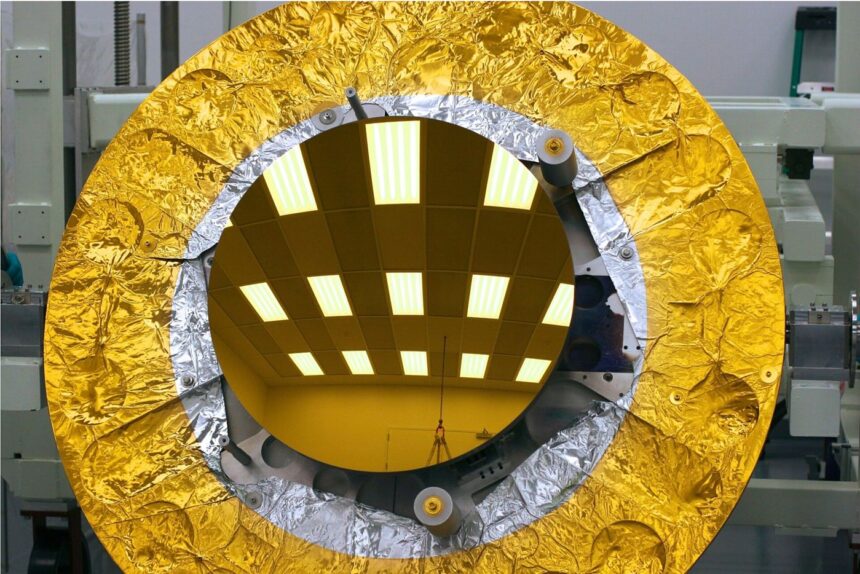
Astronomers have found a way to see planets that the James Webb Space Telescope could not see before. A team led by Northwestern University has developed a new technique, called Physics-based Learning for Imaging Planets, or FLIP, that removes the glare of a star from telescope images far more effectively than existing methods. The study was published in the journal Nature on 4 November 2026. When the team applied FLIP to two-year-old Webb observations, it revealed the giant exoplanet 51 Eridani b, which conventional processing had failed to detect, with a signal stronger than five standard deviations. Across the observations tested, the method improved the telescope’s sensitivity by between two and fifteen times, depending on the target. The advance could let astronomers find smaller, colder and fainter planets without changing the telescopes themselves, using data already sitting in archives.
What the Evidence Shows
The trick is to model the telescope itself. Instead of relying only on reference photographs, the team built a digital twin of the instrument and used techniques similar to those that train artificial intelligence models, fine-tuning millions of parameters to account for tiny imperfections, small shifts in position and distortions in the optics. The work was led by Rodrigo Ferrer-Chavez at Northwestern, and the study’s authors say the method could be applied to other telescopes too. The advance matters because the most interesting planets are the hardest to photograph: small, cold worlds orbiting close to bright stars. NASA’s proposed Habitable Worlds Observatory aims to photograph Earth-like planets around distant Sun-like stars, and techniques like FLIP could help it succeed. For now, the method has shown that old data can still hold new discoveries. Reporting and analysis from sources such as Nature track the same developments, and specialists following the FLIP technique say the direction is now consistent across independent lines of evidence.
The Wider Context
The wider context is a research landscape in which replication and open data now decide reputations. Findings connected to the FLIP technique are being checked by independent groups with shared datasets, and the teams involved publish their methods in full so rivals can test every step. That discipline is slower than a headline cycle, but it is why results in this area increasingly survive first contact with scrutiny.
What Happens Next
What happens next in the story of the FLIP technique will be decided by follow-up work already under way: larger samples, longer observation and instruments that have not yet come online. The researchers involved are unusually united on one point, that the current results justify the next investment of time and money. Readers will not have to wait long for the first tests of that claim. You can follow related developments in our coverage of science.
None of this will be settled by a single announcement, study or product launch. The pattern to watch is accumulation: independent confirmations, honest reporting of failures and steady improvement in the underlying numbers. Readers who follow those signals, rather than the loudest claim of the week, will understand this subject better than most of the commentary surrounding it suggests is possible.